


BRADE GROUP · OIL & GAS KNOWLEDGE SERIES — Asset Integrity and Pipeline Safety Series
Principles, Obstacles, and the Practical Fixes Shaping the Country’s Pipeline Network
Picture Nigeria’s pipeline grid as the body’s circulatory system. Tens of thousands of kilometres of welded steel move the country’s lifeblood — crude, gas, and refined product — out of the Niger Delta and onward to the wider economy. While the network holds, the nation earns. When it breaks, the damage travels in every direction at once: oil bleeding into creeks, communities forced to live beside fires that were never meant to burn, revenue evaporating by the billion, and Nigeria’s standing as a dependable supplier quietly slipping.
Between 1976 and 2014, published research estimates that about 12,000 spill incidents released roughly 3.1 million barrels of crude into the Niger Delta, while broader environmental reporting continues to describe cumulative pollution across the region in much larger terms (Chinedu and Chukwuemeka, 2018; Earth Island Journal, 2025). A large share of those losses had nothing to do with sabotage. They traced back to something far more ordinary and far more fixable: corrosion and mechanical failure. Steel that nobody managed. Pipe that nobody inspected. Systems that were never, in the honest sense of the word, maintained.
This piece is about the discipline that rewrites that outcome. It goes by the name Pipeline Integrity Management, and across the swamps and creeks of the Niger Delta, it may well be the most consequential engineering practice of the coming generation.
Key Takeaways
- Pipeline integrity is economic security. Nigeria’s crude, gas, and product pipelines are not just transport assets; they are revenue, energy-security, and community-safety infrastructure.
- The failure pattern is mixed. Corrosion, ageing infrastructure, third-party interference, poor records, and inconsistent enforcement interact, so no single technology or contract can solve the problem alone.
- Prevention is cheaper than reaction. Smart inspection, cathodic protection, chemical treatment, surveillance, community reporting, and disciplined maintenance cost less than spills, shut-ins, fines, clean-up, and lost trust.
- The next stage is integration. Nigeria’s strongest gains will come where engineering, data, security, regulation, and host-community participation are run as one integrity-management system.
The Circulatory System of an Economy
There is a map most Nigerians will never lay eyes on. It traces thousands of kilometres of pipe stitching through mangrove swamp, ducking beneath rivers, vanishing under farmland, and surfacing again at the export terminals that hug the Atlantic coast. A good number of these lines are older than the engineers now paid to keep them running. Some slip past within a stone’s throw of schools, homes, and open-air markets. And every last one of them, at any hour of any day, is holding back pressure.
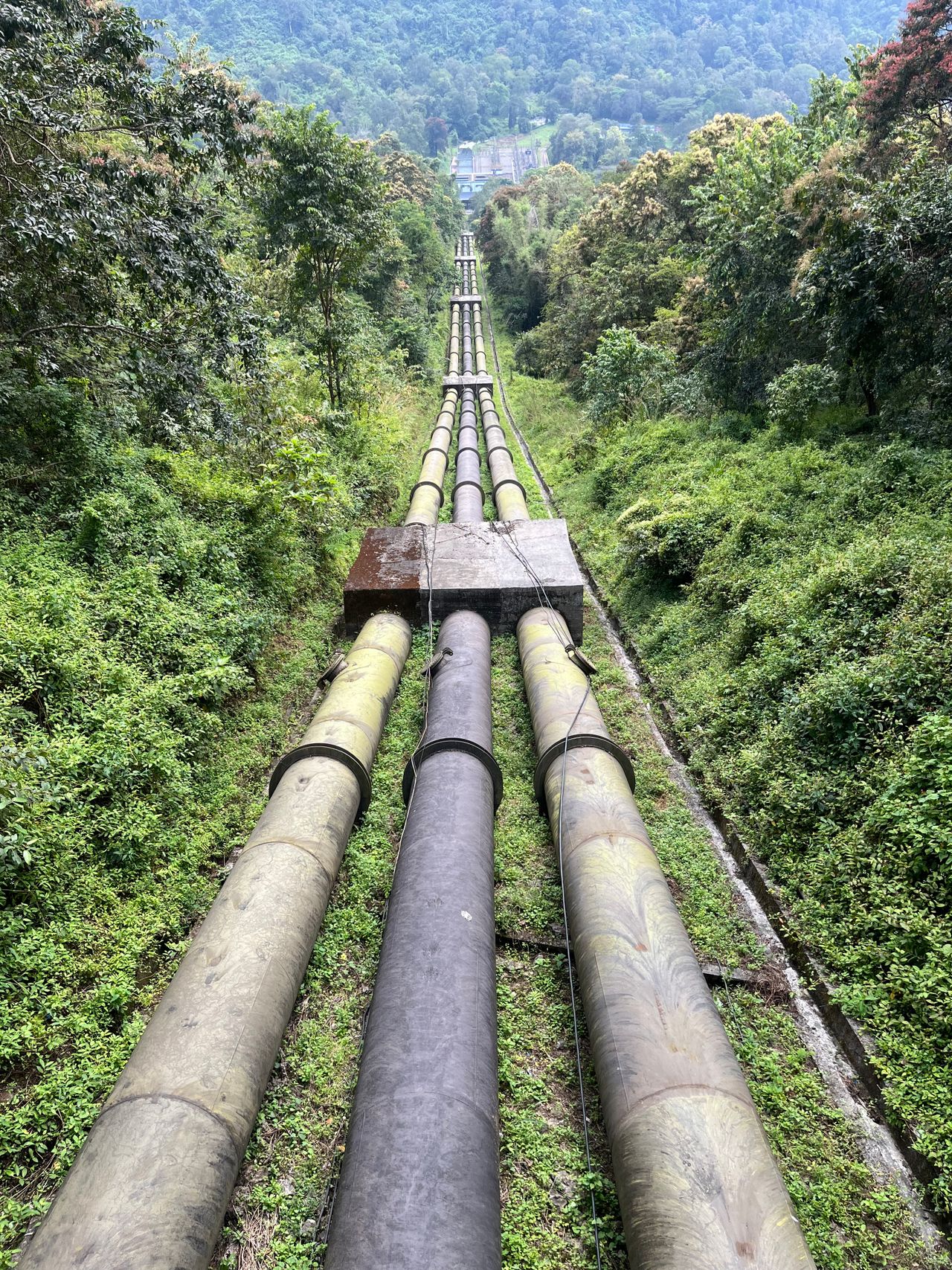
Take the NNPC-owned system on its own and you are already past five thousand kilometres of crude, gas, and product lines. Layer on top of that the thousands of additional kilometres of flowlines and gathering networks run by international majors and homegrown producers across the Delta, and the scale becomes hard to hold in the mind. Replaced from scratch, the whole thing would cost hundreds of billions of dollars. Its worth to the country, though, resists any tidy figure; petroleum earnings underwrite the federal budget, prop up state governments, and remain the single largest well of foreign exchange Nigeria has.
And yet, year after year, much of that steel has been run on a repair-it-when-it-breaks basis; patched after the failure rather than tended before it.
A pipeline rupture in the Niger Delta rarely costs only oil. It drains community goodwill, regulatory credibility, environmental standing; and, on the worst days, human life. The bill for a spill is never just the barrels lost.
A Story of Loss, and One Slowly Turning
The numbers behind Nigerian pipeline failure make for grim reading. But no column of figures can convey what a rupture actually looks like where it happens: the sheen creeping without a sound across mangrove roots, fish going belly-up in a creek that fed a village for generations, the glow of an ignited spill readable from kilometres off.
What sharpens the frustration is knowing how much of this was avoidable. The science of keeping a pipeline sound has been maturing for decades. The instruments are on the shelf. The standards sit written down. The technology is there for the buying. The shortfall was never really about engineering know-how; it was about resolve, about enforcement, and about a willingness to spend on prevention instead of waiting around for the next emergency.
That balance is finally beginning to tilt, and the evidence is out in the open. NNPC confirmed in April 2026 that national crude output had grown from a historic low of about 960,000 barrels a day in 2022 to an average of 1.71 million barrels a day in 2025, with peak production reaching 1.84 million barrels a day (NNPC, 2026; Channels Television, 2026). NNPC’s leadership tied the rebound to an integrated energy-security model built around pipeline surveillance, community involvement, regulatory oversight, industry cooperation, and coordinated security operations along the export corridors that had been bleeding crude for years.
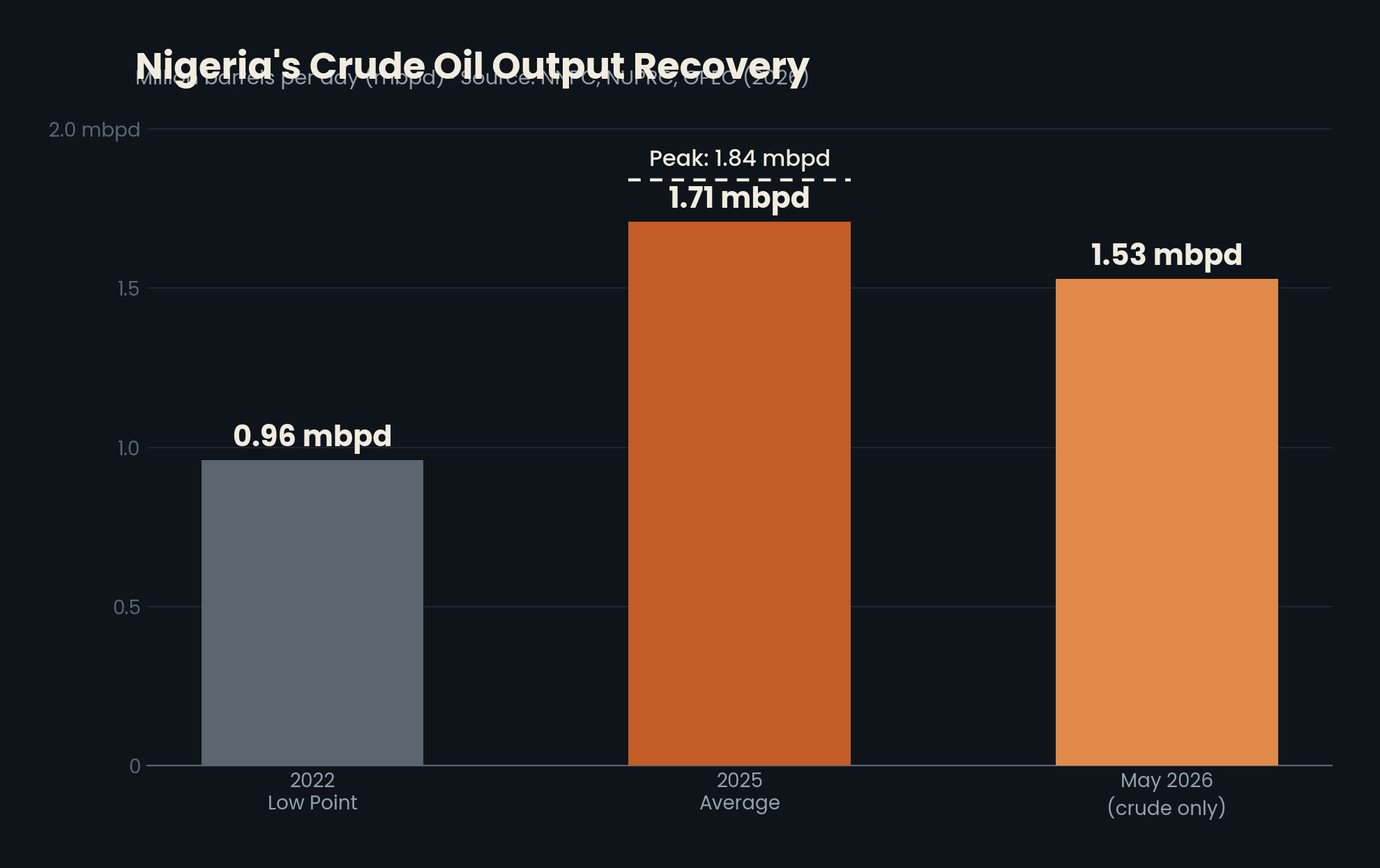
For May 2026, NUPRC and OPEC-reported data put Nigeria’s crude output at about 1.53 million barrels per day, or roughly 102 percent of its 1.5 million bpd OPEC quota; with condensates included, total crude-and-condensate output was reported at about 1.70 million bpd (NUPRC data reported by BusinessDay and Daily Trust, 2026; OPEC data reported by Nairametrics, 2026).
The takeaway is blunt: guarding the pipe and guarding the revenue are not two goals. They are one.
What a Pipeline Integrity Management System Really Is
The term “Pipeline Integrity Management System” has a bureaucratic ring to it. On the ground, it is nothing of the sort.
Strip away the jargon and a PIMS is simply an organised, well-documented way of combining processes, technology, and human judgement so that a pipeline keeps doing the one job it was built for — moving product safely, for the whole of its working life (NDT Global, 2025). The worldwide market for the technology that supports this work was put at about USD 10.1 billion in 2024 and is forecast to climb toward USD 15.2 billion by 2032 (Verified Market Research, 2025). That is expansion of roughly 5 percent a year, and it exists for one reason: operators the world over have discovered, often through painful experience, that heading trouble off early is both safer and dramatically cheaper than scrambling to fix a failure after the fact.
A serious PIMS is never a single gadget or a single binder on a shelf. It is a living arrangement resting on six pillars that lean on one another.
- Data at the Core. Gathering, storing, and making sense of everything that tells you how a pipeline is holding up: original design specs, construction records, past inspections, day-to-day operating data, and incident logs. A PIMS starved of good data is a house raised on sand.
- Threat and Risk Assessment. Naming and sizing up every hazard the line faces — corrosion, mechanical damage, ground movement, outside interference — then weighing, formally, how likely each is to strike and how badly it would hurt.
- Integrity Assessment Methods. The toolkit for reading a pipe’s actual, present-day condition: smart pigging, direct assessment, pressure testing, and the newer digital approaches now entering the picture.
- Prevention and Mitigation. The engineering controls, chemical dosing, physical barriers, and operating rules that stop a known threat from ever maturing into a failure.
- Performance Monitoring and KPIs. Clear targets and measures that tell you whether the system is actually working. You cannot sharpen what you refuse to measure.
- Management Review and Continuous Improvement. Regular, senior-level scrutiny of how the PIMS is performing, with the lessons from inspections, incidents, and near-misses fed methodically back into the loop.
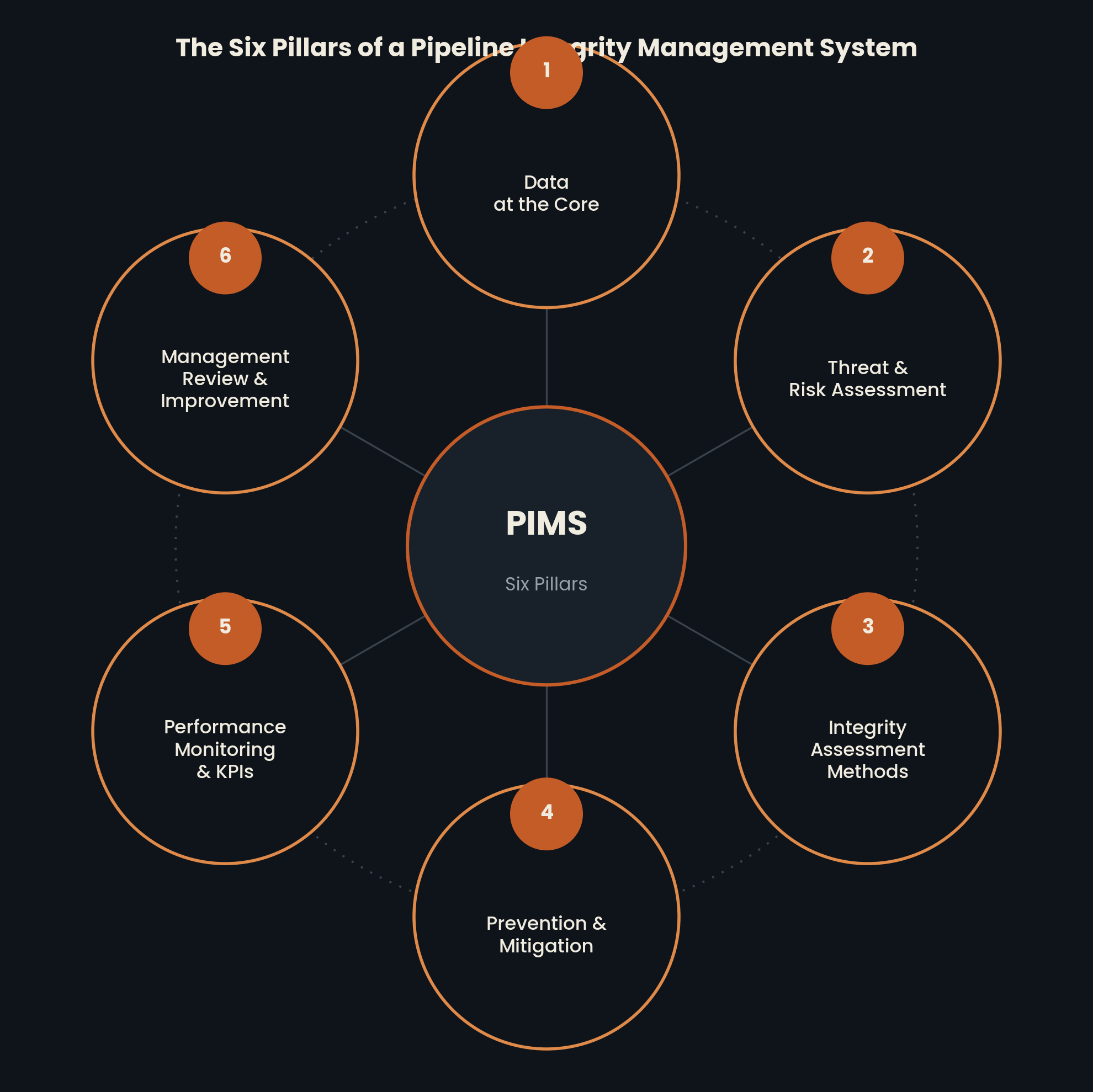
These six do not sit in isolation; they are in constant conversation. The data pulled together in the first pillar feeds the risk work in the second. That risk picture decides which assessment methods in the third pillar get run first. The findings from those runs shape the prevention measures in the fourth. And the KPIs in the fifth are what tell leadership whether the machine as a whole is behaving as intended. Knock out any single pillar and the whole structure starts to wobble.
What Is Trying to Destroy Nigeria’s Pipelines
The forces working against pipeline integrity in Nigeria do not come one at a time. They arrive as a crowd: some natural, some chemical, some human, often pushing in the same direction and feeding off one another. Getting to grips with them is the groundwork for any PIMS worth the name.
Internal Corrosion: the Enemy Inside the Pipe
Of all the natural threats, internal corrosion is the one that dominates Nigerian oil and gas lines. It goes to work from the inside, out of sight, and it never once pauses. Three distinct mechanisms tend to be running at the same time.
Sweet corrosion (CO₂). Carbon dioxide dissolves into the water that rides along with produced crude and gas and turns into carbonic acid. That acid gnaws at the carbon-steel wall, leaving pits in some places and thinning the whole wall in others. Across the gas-heavy fields of the Delta, CO₂ in the produced stream can run anywhere from 1 to 15 percent, which keeps sweet corrosion in play in practically every gathering flowline and trunk line in the region.
Sour corrosion (H₂S). Where hydrogen sulphide shows up in the fluids, the attack becomes nastier and far harder to predict. Sour service can crack a pipe wall suddenly and brittly at stresses well under what the steel was rated to take, frequently with no warning at all before it lets go. In the Delta’s sour reservoir intervals, that is a real and serious danger, and it calls for purpose-rated materials and constant watchfulness.
Microbial corrosion (MIC). Sulphate-reducing bacteria settle into stagnant produced water and sluggish stretches of line, throwing off H₂S as they feed and speeding corrosion along even in pipes that are officially “sweet.” The slow-moving and dead-leg sections of Nigeria’s older systems are especially exposed, because low flow lets the bacterial colonies dig in and multiply undisturbed.
External Corrosion: the Enemy Outside the Pipe
External corrosion works the other side of the steel, chewing at buried and submerged lines wherever the protective coating has been nicked, has aged, or has simply been breached. The Niger Delta happens to serve up an unusually brutal setting for it: briny swamp water, mangrove roots that press into and pierce coatings, and microbes thriving in the oxygen-starved sediment all pile on to strip metal from the pipe’s outer skin.
The front-line defence is cathodic protection: electrochemical systems that push back against the corrosion reaction right at the metal surface. But whether they earn their keep comes down entirely to sound installation, routine testing, and unglamorous, disciplined upkeep. A cathodic protection system that gets installed and then never checked is not a safeguard at all. It is paperwork.
Third-Party Interference and Sabotage: the Enemy With Hands
If internal and external corrosion are the adversaries every PIMS on Earth has to reckon with, third-party interference is the one Nigeria’s frameworks have to confront more squarely, more inventively, and more honestly than almost anywhere else.
Theft crews drill hot taps straight into live lines to siphon crude for backyard refining. Sections of pipe get cut or blown as a form of protest. Militant groups have, over the years, hit export infrastructure deliberately as a lever of economic and political pressure. None of this is predictable, none of it registers on any corrosion monitor, and together it accounts for a heavy slice of the country’s pipeline failure record.
A 2025 review by Igbesi and Enaghinor pinpointed exactly this as the blind spot in today’s integrity models (American Journal of Engineering, Mechanics and Architecture, 2025). Machine-learning systems built to forecast corrosion are getting genuinely good, but they were never designed to see a saboteur, and for the most part they cannot. The authors argued for community surveillance networks, digital twins, and real policy enforcement to be written formally into PIMS frameworks tailored to the Nigerian setting rather than bolted on as an afterthought.
The Deep-Burial Fix and What It Actually Costs
One physical answer to third-party interference that has proven itself is deep burial: dropping the more exposed sections 3 to 5 metres down instead of the usual 0.9 to 1.5 metres, which makes drilling a hot tap far more trouble than it is worth.
A 2021 study by Agomuoh, Ossia, and Chukwuma found that this approach added about 9.6 percent to the build cost of a typical 20-inch, 15-kilometre Delta trunkline (World Journal of Engineering and Technology, Agomuoh et al., 2021). Quoting that as a fixed naira figure no longer means much; currency moves and inflation between 2021 and 2026 have shifted absolute project costs considerably. The percentage premium, though, holds up as a dependable planning number whenever the project is priced. The useful question for a modern operator is what 9.6 percent of today’s CAPEX comes to, and whether that outlay is recovered by dodging the losses of even one spill.
The study’s verdict left no room for hedging: that premium is not really a cost. It is insurance. Set it against the fallout of a single major vandalism spill — a shut-in field, an emergency repair, environmental clean-up, regulatory fines — and the extra burial spend pays for itself many times over.
Geotechnical Threats: the Enemy the Ground Itself Makes
The Niger Delta is not solid, settled land. It is a restless geological place: subsiding in spots, eroding along riverbanks, flooding by season, and shifting soil that can travel metre by metre over the years. A line buried safely decades ago may now sit exposed by a river that wandered, hanging unsupported across a washout, or bearing loads from ground movement its designers never once pictured.
Watching for all this — through aerial surveys, satellite-based ground-movement tracking, and bathymetric surveys of river crossings — is an essential piece of any Nigerian PIMS, and one that is too often left underfunded. An exposed pipe in a creek is more than a corrosion problem. It is an open invitation to every boat that passes and everyone who stands to gain from what moves inside it.
Seeing Inside the Pipe: the Technologies of Integrity Assessment
The central paradox of pipeline integrity is this: the very thing you most need to examine is the one thing you can least easily reach — the inside of a pressurised steel tube buried under swamp, river, or forest floor. The technologies built to crack that problem rank among the most ingenious engineering in the entire oil and gas business.
Inline Inspection: the Smart Pig That Sees Everything
The most capable way to size up a pipeline without shutting it down is inline inspection using an intelligent pipeline inspection gauge — a “smart pig” in the trade. The odd name is a leftover from the squeal that early cleaning pigs made scraping their way through a line. The modern descendant is anything but crude.
A smart pig rides the product flow, shoved forward by the pressure at its back, logging a continuous read of the pipe wall’s condition as it goes. When it slides out at the receiving trap, it brings with it a detailed chart of every anomaly, every patch of thinning steel, every dent and deformation across the length it covered. That record then sets the maintenance order of battle: the worst defects get fixed first, while the spots that can safely wait are simply kept under watch.
- Magnetic Flux Leakage (MFL). The workhorse ILI method across Nigeria. The pig magnetises the pipe wall, and defects throw off small distortions in the magnetic field that the sensors pick up and map. Excellent at catching metal loss from corrosion, pitting, and selective seam corrosion; fast, dependable, and battle-tested over thousands of kilometres of Nigerian line.
- Ultrasonic Testing (UT). Fires ultrasonic pulses to gauge wall thickness directly, at finer resolution than MFL. Especially good for finding cracks and pinning down exactly how much wall remains. It needs a liquid to carry the signal, which suits it to liquid-filled lines but means gas lines require special provision.
- Geometry Inspection. Reads the bore of the pipe to catch dents, out-of-round sections, and deformations left by mechanical damage, ground loading, or buckling — particularly relevant in Nigeria, where hot-tap work leaves its own tell-tale deformation signatures.
- Acoustic Resonance Technology (ART). A newer, high-resolution option that measures wall thickness directly all the way around the pipe. It shines in combination runs that pick up both general corrosion and pitting in a single pass.
Direct Assessment: When the Pig Simply Cannot Go In
Here is a problem that defines integrity work in Nigeria specifically: a large chunk of the country’s pipe stock is not piggable at all. The flowlines run too short, the bends turn too tight, or the launch and receive facilities were simply never installed. Those systems demand a different playbook.
Direct assessment is a structured way of using above-ground readings, flow modelling, and operating history to work out where along a non-piggable line corrosion is most likely lurking, then aiming inspection precisely at those points. Almost anywhere else, the next move would be a straightforward dig. In the Delta’s shifting terrain, nothing about that is straightforward.
Digging in swamp piles cost upon cost: security escorts across much of the onshore acreage, disruption to the community at every excavation, and the sheer logistical grind of reaching buried pipe in waterlogged ground, where one dig can call for dewatering rigs, barges, and days of mobilisation. And in areas where interference is already active, every excavation hands the pipe’s precise location to the very people most eager to exploit it.
So current best practice is to slip a non-invasive screening layer in ahead of any dig. Long-Range Ultrasonic Testing (LRUT) clamps transducer rings around a single accessible exposure and sends guided ultrasonic waves along the wall for up to 100 metres in each direction, flagging zones of serious wall loss without turning a single spade of extra soil. Clamp-on acoustic-emission sensors can likewise pick up live corrosion and cracking signals over long runs from one surface point. Together these tools shrink the dig list down to only the confirmed worst offenders, keeping direct assessment sensible and proportionate even where physical access is expensive, disruptive, and, frankly, hazardous.
- External Corrosion Direct Assessment (ECDA) checks how well the cathodic protection is performing and what shape the coating is in, using above-ground instruments, before excavating and inspecting the wall directly at the riskiest spots.
- Internal Corrosion Direct Assessment (ICDA) leans on flow modelling and operating data to find the stretches where liquid pools and sets up ideal conditions for internal attack, then singles those out for direct measurement.
- Stress Corrosion Cracking Direct Assessment (SCCDA) locates the spots prone to SCC based on soil, coating, and cathodic-protection conditions, then brings in magnetic particle inspection or ultrasonic testing to hunt for developing cracks.
Digital Twins: the Pipeline That Lives in a Computer
Between ILI runs, which on a well-run line might come around only every three to five years, an operator is essentially flying half-blind. They know the condition as of the last inspection. What they do not know, with any precision, is how things have drifted since. Digital-twin technology is starting to close that gap.
A pipeline digital twin is a constantly refreshed virtual double of the real line, built from design data and tuned against live operating and inspection results. It models how corrosion is advancing between inspection cycles. It folds CP survey readings, flow data, leak-detection alarms, and inspection findings into one unified risk picture. And when something moves in the physical world — whether a change in flow, a shift in water cut, or a fresh CP reading — the twin revises its forecast to match.
This is no longer laboratory science in Nigeria. The Akselos structural digital twin deployed on Shell’s Bonga Main FPSO, sitting some 120 kilometres offshore of the Niger Delta, showed that the technology can hold up in genuine Nigerian offshore conditions (Offshore Technology / SNEPCo, 2020). As the price falls and the underlying data infrastructure matures, extending twins to pipeline systems is the obvious next step for operators who want to graduate from periodic snapshots to continuous, always-on awareness.
The Cybersecurity Risk You Cannot Wish Away
A digital twin that pools a pipeline’s operating data onto a networked platform, and a DAS fibre network that reports every tremor along a corridor in real time, is also, if it is poorly defended, a precise map of Nigeria’s most critical energy infrastructure, laid open to anyone who can get through the network.
State-backed actors and capable saboteurs have already shown, in well-documented incidents around the world, that they can reach into industrial control systems and connected sensor networks to inflict physical damage or blind leak detection outright. The 2021 Colonial Pipeline ransomware attack in the United States and the 2022 strikes on European energy infrastructure both make the point plainly: pipeline digital systems are live targets, not theoretical ones.
So Nigerian operators rolling out twins and connected IoT sensors have to build them on secure, air-gapped or strongly encrypted control networks aligned with the IEC 62443 cybersecurity standards for industrial automation. Access controls, intrusion detection, and regular penetration testing are not optional trimmings on a digital integrity programme. They are load-bearing: leave them out and the digital layer becomes the vulnerability it was meant to guard against.
A pipeline watched continuously is a different animal from one checked once every five years. The threat has not changed. What has changed completely is the operator’s chance to act on it before it turns into a crisis.
Holding the Line: Prevention, Mitigation, and Surveillance
Understanding what threatens a pipeline is necessary, but it settles nothing on its own. The real substance of integrity management is what you do next: the active steps that keep the threat and the failure from ever meeting.
Chemical Treatment With Corrosion Inhibitors
Dosing corrosion inhibitor continuously, straight into the crude or gas stream, is one of the most effective and widely used prevention measures in Nigeria. Inhibitor molecules lay down a thin protective film on the inner wall and choke off the electrochemical reactions that drive corrosion. Scale inhibitors keep deposits from building up and creating corrosion hot spots beneath them. Biocides go after the sulphate-reducing bacteria behind microbial corrosion.
Whether such a programme actually works comes down to three things: picking the right product for the specific corrosion environment, holding the dosing steady over time, and sampling and testing often enough to confirm the treatment is hitting its target residual concentrations the length of the line. A programme that is perfectly designed but applied on and off delivers a fraction of what its design promised.
BRADE Group’s Chemical and Specialty Fluid Supply division supplies formulated corrosion inhibitors, scale inhibitors, and biocides to Nigerian upstream operators, drawing on technology partners whose chemistries have been proven against real Niger Delta production conditions.
Cathodic Protection
Every buried and submerged line in Nigeria has to be shielded by cathodic protection meeting NACE SP0169 or ISO 15589. A CP system makes the pipe wall the cathode of an electrochemical cell, heading off the anodic dissolution of steel that is corrosion by another name. Impressed-current systems run an external power source to keep the protective current flowing; sacrificial-anode systems use metals like zinc or magnesium that corrode in the pipe’s place, spending themselves to spare it.
Yearly CP surveys, measuring pipe-to-soil potential at set intervals along the route, are required under NUPRC rules and are the only real way to confirm the protection criteria are being met. A line whose CP system was last surveyed three years ago is not a line with cathodic protection. It is a line that used to have it.
Surveillance and Leak Detection: the Watching System
A modern Nigerian PIMS stacks several surveillance technologies over the same corridor, precisely because no single one catches everything.
- Aerial and drone patrols give regular eyes on the right-of-way, spotting visible leaks such as oil sheen on water, dying vegetation, and vapour plumes, along with encroachment and the signatures of hot-tapping. Drones have made this cheaper, quicker, and more frequent than the helicopter overflights they now supplement.
- Distributed Acoustic Sensing (DAS) and Distributed Temperature Sensing (DTS) run fibre-optic cable alongside the route to catch vibration patterns that match digging or hot-tapping, and temperature swings that match a product release. They deliver continuous, real-time awareness of everything unfolding along the corridor: day, night, any weather.
- Computational Pipeline Monitoring (CPM) keeps comparing the flow going into and out of each section, raising a flag on any imbalance that hints at a leak. Mass-balance and pressure-gradient methods can catch losses as small as 1 to 2 percent of throughput, well beneath what any physical inspection could ever see.
- Community-based surveillance has turned out to be one of the sharpest tools of all. When host-community members are treated as partners rather than nuisances, given training and a reporting channel that actually works, and shown a credible response whenever they raise the alarm, they become the most fine-grained, tireless, and motivated watch network any operator could hope to field. In June 2026, Vanguard reported that PINL’s Trans-Niger Pipeline work involved a surveillance network spanning 216 host communities and that the company reported zero infractions in its May stakeholder engagement report (Vanguard, 2026).
The Rules and the Reality: Nigeria’s Regulatory Framework
Nigeria’s rulebook for pipeline integrity is more thorough than most outsiders assume. The trouble has seldom been an absence of rules. It has been the distance between what those rules demand and what actually happens out in the field.
NUPRC: the Upstream Regulator
The Nigerian Upstream Petroleum Regulatory Commission requires upstream operators to manage safety, inspection, risk-based inspection, documentation of inspection, process-safety management, critical equipment, upstream pipeline operations, and accident reporting under the Upstream Petroleum Safety Regulations, 2024 (NUPRC, 2024). For operators, that means a credible PIMS must be capable of producing auditable records on inspections, anomaly response, corrosion monitoring, cathodic protection, leak detection, and incident investigation whenever the regulator asks for evidence.
NMDPRA: the Midstream and Downstream Regulator
The Nigerian Midstream and Downstream Petroleum Regulatory Authority handles the integrity requirements for NNPC’s product-distribution lines, including the Atlas Cove to Mosimi system and the midstream reaches of the Trans-Niger Pipeline. Because the Petroleum Industry Act of 2021 set up parallel regulators, a product line that crosses from upstream gathering into midstream transport can end up answering to two regimes at once — a wrinkle that rewards deliberate planning and punishes improvisation.
The most workable response is a single, unified compliance framework: map each segment cleanly to the authority that governs it, keep dual-format reporting packs ready to file with NUPRC and NMDPRA at the same time, and put one Regulatory Affairs lead in charge of coordinating joint submissions and keeping track of deadlines that do not line up. Over the long run, Nigeria would be better served still by a joint NUPRC-NMDPRA digital clearing-house: a shared platform where an operator submits one integrated integrity-and-production dataset that both regulators can draw on independently, doing away with duplicated formats and clashing compliance calendars that add cost and friction to every cross-boundary line.
International Standards: the Technical Benchmark
More and more, Nigerian operators line their PIMS up with international standards, partly because those standards represent the best engineering thinking available, and partly because international lenders and partners increasingly insist on them. The core set includes ASME B31.8S for gas-pipeline integrity management, API RP 1160 for hazardous-liquid pipeline integrity management, DNV-RP-F101 for assessment of corroded pipelines, and ISO 55000 for asset-management principles. Falling in line with these is not box-ticking. It is a signal to investors, insurers, and trading partners that Nigerian pipeline operations can be counted on.
The Honest Account: Challenges and the Responses They Demand
No account of Nigerian pipeline integrity would be complete without a frank look at what stands in the way. These are not alibis. They are the particular problems that particular solutions have to meet head-on.
| The Challenge in Nigeria | The Response It Calls For |
|---|---|
| Thin data infrastructure and patchy historical records | Invest in digital data management and go back to digitise the inspection records that were never captured |
| Many flowlines simply cannot be pigged (too short, bends too tight) | Apply direct-assessment methods now, and design the next generation of pipe to be piggable from day one |
| Sabotage is unpredictable and invisible to corrosion models | Build community engagement and DAS fibre-optic monitoring directly into the PIMS |
| Regulatory enforcement varies from operator to operator | Have NUPRC strengthen its audit programme and publish transparent, tiered compliance indicators that encourage improvement without turning enforcement into a public naming exercise |
| Shortage of local PIMS expertise and data analysts | Partner with NCDMB on local-content training in pipeline integrity engineering |
| Ageing lines running past their original design life | Commission life-extension studies and set time-bound replacement programmes |
| Too little money set aside for decommissioning | Enforce mandatory financial security under the PIA 2021 Decommissioning Regulations |
Every row in that table is really a fork in the road, not just a problem statement: will the operator, the regulator, or the government treat the situation as an acceptable fact of life, or as an engineering challenge with a known answer? The technology to solve each one already exists. What remains uncertain, every time, is whether the will to use it shows up alongside it.
Nigeria does not lack the knowledge to protect its pipelines. What it sometimes lacks is the institutional resolve to apply that knowledge consistently, across every operator, in every setting, no matter the short-term squeeze on the balance sheet.
The Line That Must Hold
Somewhere in the Niger Delta, right now, a pipeline is carrying crude under pressure through swamp that is openly hostile to steel. Bacteria are working to eat it from within. Salt water is working to corrode it from without. And somewhere along its length there may be a person holding a drill bit, looking at that pipe and seeing not national infrastructure but an opportunity.
Pipeline integrity management is what stands in the gap between that line and everything that follows its failure: the oil on the water, the fire on the creek, the community stripped of its livelihood, the government stripped of its revenue, the operator stripped of its social licence to keep working.
The tools are real. The standards are written. The technology is proven. The regulatory framework, flawed as it is, still gives enforcement something to stand on. What integrity management in Nigeria demands, more than anything, is the steady, disciplined, properly funded application of things that are already well understood.
The production recovery reported across 2025 and into 2026 tells the story of what happens when that discipline begins to show up. Nigeria moved from the 2022 low of about 960,000 barrels a day to a verified 2025 average of about 1.71 million barrels a day, then recorded roughly 1.53 million barrels a day of crude output in May 2026, above its OPEC quota for that month. Those gains were not presented as the result of a single new discovery, but of improved security, steadier operations, and more deliberate protection of infrastructure already in place.
That is the real promise of pipeline integrity management. Not glamour, not a breakthrough gadget, not one dramatic rescue. Just the patient, unshowy work of keeping the steel sound and the product moving.
The pipeline that does not fail is the pipeline that funds the hospital, powers the school, and keeps the national economy turning. Integrity management is not a cost. It is the return on every kilometre of pipe this country has ever laid.
BRADE Group Perspective
For BRADE Group, pipeline integrity is not a narrow technical service; it is a practical operating discipline that links the right chemicals, the right field practices, the right partners, and the right reporting culture. In that discipline, corrosion inhibitors, scale inhibitors, biocides, surveillance support, inspection planning, and asset-integrity advisory work are not separate offerings. They are parts of the same promise: helping operators keep critical infrastructure safe, productive, and commercially reliable.
That is where BRADE’s value is clearest: translating integrity-management principles into field-ready solutions that suit Nigerian operating realities, from hostile Delta terrain and ageing pipe stock to demanding production targets and increasingly data-driven regulatory scrutiny.
Glossary: Plain-Language Guide to Key Terms
A quick guide to the technical vocabulary in this article, written for readers new to pipeline engineering and integrity management.
- PIMS (Pipeline Integrity Management System) — An organised, well-documented framework of processes, technology, and human judgement that keeps a pipeline running safely and reliably for the whole of its life. It spans data management, threat assessment, inspection, prevention, monitoring, and continuous improvement.
- Internal Corrosion — Corrosion of the inner wall driven by the chemistry and biology of the fluids passing through. In Nigerian lines it comes mainly from CO₂ (sweet corrosion), H₂S (sour corrosion), and sulphate-reducing bacteria (microbial corrosion).
- External Corrosion — Corrosion of the outer wall driven by the surrounding soil, water, or marine environment. Held off mainly by protective coatings and cathodic protection.
- Cathodic Protection (CP) — An electrochemical way of stopping corrosion on buried or submerged metal. It makes the pipe wall the cathode of a cell, preventing the steel from dissolving. Nigeria uses two kinds: impressed-current CP (external power) and sacrificial-anode CP (zinc or magnesium that corrodes in the pipe’s place).
- ILI / Smart Pigging — Inline inspection using intelligent pipeline inspection gauges (smart pigs) fitted with sensors that read a pipe’s interior while it stays in service, logging wall thickness, anomalies, and geometry along the full length.
- MFL (Magnetic Flux Leakage) — The most common ILI method in Nigeria. The pig magnetises the wall, and corrosion defects distort the magnetic field in ways the sensors detect and map. Very good at catching metal loss from corrosion, pitting, and selective seam corrosion.
- ECDA (External Corrosion Direct Assessment) — A structured method for non-piggable lines that reads CP performance and coating condition from above ground to find where external corrosion is most likely, then digs and inspects those points directly.
- ICDA (Internal Corrosion Direct Assessment) — A structured method for non-piggable lines that uses flow modelling and operating history to find where internal corrosion is likely concentrated, then targets those stretches for direct measurement.
- Hot Tap — A connection made to a pressurised line while it stays in service: illegal in oil theft, planned in some maintenance work. Delta theft crews use hot taps to draw off crude without shutting the line down, creating uncontrolled leaks and fire hazards.
- DAS (Distributed Acoustic Sensing) — Fibre-optic surveillance that reads vibration and sound along a cable beside the pipe, catching digging, hot-tapping, interference, and leaks in real time over many kilometres from one monitoring point.
- CPM (Computational Pipeline Monitoring) — Software-based leak detection that continuously compares flow in and out of a section. Meaningful imbalances trigger alarms and can flag losses as small as 1 to 2 percent of throughput, far below anything a surface inspection would see.
- CO₂ Corrosion (Sweet Corrosion) — Internal corrosion from carbon dioxide dissolved in produced water. The CO₂ forms carbonic acid, which pits and thins the carbon-steel wall. Common in the gas-rich Delta, where CO₂ in the stream can reach 15 percent.
- MIC (Microbiologically Influenced Corrosion) — Corrosion driven by microbes, especially sulphate-reducing bacteria, that settle in stagnant or slow-moving sections. They give off H₂S as they feed, speeding corrosion even in lines carrying nominally sweet fluids.
- Digital Twin — A continuously updated virtual double of a physical asset, in this case a pipeline. Built from design data and tuned with live operating and inspection results, it models how the pipe’s condition is changing between inspections, enabling risk-based planning and early warning.
- Deep Burial — A construction and anti-vandalism strategy that buries a line 3 to 5 metres down rather than the usual 0.9 to 1.5 metres, making hot-tapping much harder and putting the pipe further out of reach of interference.
- NUPRC — Nigerian Upstream Petroleum Regulatory Commission. Set up under the Petroleum Industry Act 2021 to regulate upstream operations, including all integrity and safety requirements for upstream crude, gas, and condensate lines.
- NMDPRA — Nigerian Midstream and Downstream Petroleum Regulatory Authority. Set up under the PIA 2021 to regulate midstream and downstream activity, including the NNPC pipeline and product-distribution network.
- ASME B31.8S — An American Society of Mechanical Engineers standard for managing the system integrity of gas pipelines. The 2022 edition was in force when many current integrity programmes were developed, and ASME has since issued a 2025 edition.
- API RP 1160 — An American Petroleum Institute recommended practice for managing the integrity of hazardous-liquid pipelines, including crude lines. The third edition was published in 2019 and reaffirmed in 2024.
- DNV RP-F101 — A DNV recommended practice for assessing corroded pipelines. It provides methods for calculating the remaining strength of a wall that has lost thickness to corrosion and judging whether the line can safely remain in service; the current document is the 2019 edition with later amendments.
Sources and Further Reading
- Igbesi, F. C., and Enaghinor, L. A. (2025). Predictive Modelling, Corrosion Control, and Human-Induced Failures in Pipeline Systems: A Review with Focus on Niger Delta Region of Nigeria. American Journal of Engineering, Mechanics and Architecture, Vol. 3, No. 7.
- Agomuoh, A. E., Ossia, C. V., and Chukwuma, F. O. (2021). Asset Integrity Management in Mitigating Oil and Gas Pipeline Vandalism in the Niger Delta Region: Deep Burial Solution. World Journal of Engineering and Technology, Vol. 9, pp. 565-578.
- Chinedu, E., and Chukwuemeka, C. K. (2018). Oil Spillage and Heavy Metals Toxicity Risk in the Niger Delta, Nigeria. Journal of Health and Pollution, Vol. 8, No. 19, Article 180905.
- Ikoku, O. (2025). Big Oil Is Deserting the Polluted Niger Delta. Earth Island Journal, Autumn 2025.
- Nigerian National Petroleum Company Limited. (2026). Pipeline Security: We’ve Seen Production Growth — NNPC. Press release, 8 April 2026. Supported by Channels Television, Oil Production Hits 1.84m/bpd on Improved Pipeline Security — NNPC, 9 April 2026.
- Vanguard News. (2026). Trans Niger Pipeline Operations Support Nigeria’s 80% Oil Production Recovery. 13 June 2026.
- Daily Trust. (2026). Pipeline Security Yielding Results with 1.53m bpd Output — PINL. 24 June 2026.
- BusinessDay. (2026). Nigeria Meets 102% of OPEC Quota as Crude Oil Production Hit 1.7mn bpd in May. 11 June 2026.
- Nairametrics. (2026). Nigeria’s Oil Output Hits 1.53 mbpd, Highest Since July 2025. 11 June 2026.
- Akari, I. (2026). How Pipeline Security Is Reviving Nigeria’s Struggling Crude Sector. Independent Nigeria, 21 March 2026.
- Offshore Technology / Shell Nigeria Exploration and Production Company (SNEPCo) (2020). Shell’s Bonga FPSO in Nigeria Gets Digital Twin from Akselos.
- Verified Market Research. (2025). Pipeline Integrity Management Systems Market Size and Forecast, 2026-2032.
- NDT Global (2025). Pipeline Integrity Management System, Glossary. ndtglobal.com.
- Nigerian Upstream Petroleum Regulatory Commission. (2024). Nigerian Upstream Petroleum Safety Regulations, 2024. Federal Republic of Nigeria Official Gazette No. 62, Government Notice No. 73, 10 April 2024.
- American Society of Mechanical Engineers. (2025). ASME B31.8S: Managing System Integrity of Gas Pipelines. New York: ASME.
- American Petroleum Institute. (2019; reaffirmed 2024). API RP 1160: Managing System Integrity for Hazardous Liquid Pipelines, 3rd ed. Washington, D.C.: API.
- DNV. (2019; amended 2025). DNV-RP-F101: Corroded Pipelines. Høvik, Norway: DNV.
- International Organization for Standardization. ISO 55000, Asset Management: Overview, Principles and Terminology. Geneva: ISO.
- NACE International. NACE SP0169, Control of External Corrosion on Underground or Submerged Metallic Piping Systems.
- International Electrotechnical Commission. IEC 62443, Industrial Communication Networks: Network and System Security.
- Federal Republic of Nigeria (2021). Petroleum Industry Act (PIA), 2021.