BRADE GROUP · OIL & GAS KNOWLEDGE SERIES · WELL ENGINEERING AND SUBSURFACE SERIES
The Complete Life of an Oil and Gas Well: From Exploration to Decommissioning, the Nigerian Perspective
By Benjamin Odiputan
On August 3, 1956, a drill bit turned for the last time at a depth of around 1,500 metres beneath a small community in present-day Bayelsa State. The earth gave up what it had held for millions of years. Nigeria’s commercial oil history had begun.
That well at Oloibiri was the first chapter of a story that has since been repeated thousands of times across the Niger Delta and its offshore waters. Each well tells the same story in broad outline: a beginning filled with geological promise and capital risk; a productive middle during which the earth’s wealth flows to the surface; and an ending that must be managed as carefully as the beginning.
This article traces that complete journey, every stage from the first geophysical survey to the final plug of cement sealing a spent reservoir. It is a journey that takes decades, spans enormous technical complexity, and carries consequences; economic, environmental, and social; that outlast the well itself.
Nigeria’s Wells: A Story That Began in 1956
The well at Oloibiri no longer produces. The wooden derrick that once marked the spot is gone. The community that hosted Shell-BP’s first successful strike has, over the decades, watched the infrastructure of that discovery age, decline, and fall mostly silent. In a sense, Oloibiri is a portrait of the entire Nigerian petroleum story compressed into a single location: the promise, the production, the decline, and the difficult question of what comes after.
Nigeria today holds approximately 37 billion barrels of proven oil reserves and over 200 trillion cubic feet of natural gas reserves (National Petroleum Reserves Declaration, NUPRC, 2025). Thousands of wells produce across the Niger Delta’s onshore and offshore acreage. The country’s petroleum revenues fund the federal government, support state administrations, and represent the largest single source of foreign exchange in the national economy.
Every one of those wells has a life. Not a metaphorical life, but a structured, regulated, technically defined life cycle that begins long before the drill bit turns and ends long after the last barrel flows. Understanding that life cycle; in all its technical, economic, regulatory, and human dimensions; is fundamental to understanding the Nigerian oil and gas industry itself.
A well is not just a hole in the ground. It is an investment measured in hundreds of millions of dollars, a technical achievement decade in the making, a source of national revenue, and eventually, a responsibility that must be honored even when the money has stopped flowing.
The Six Stages: An Overview
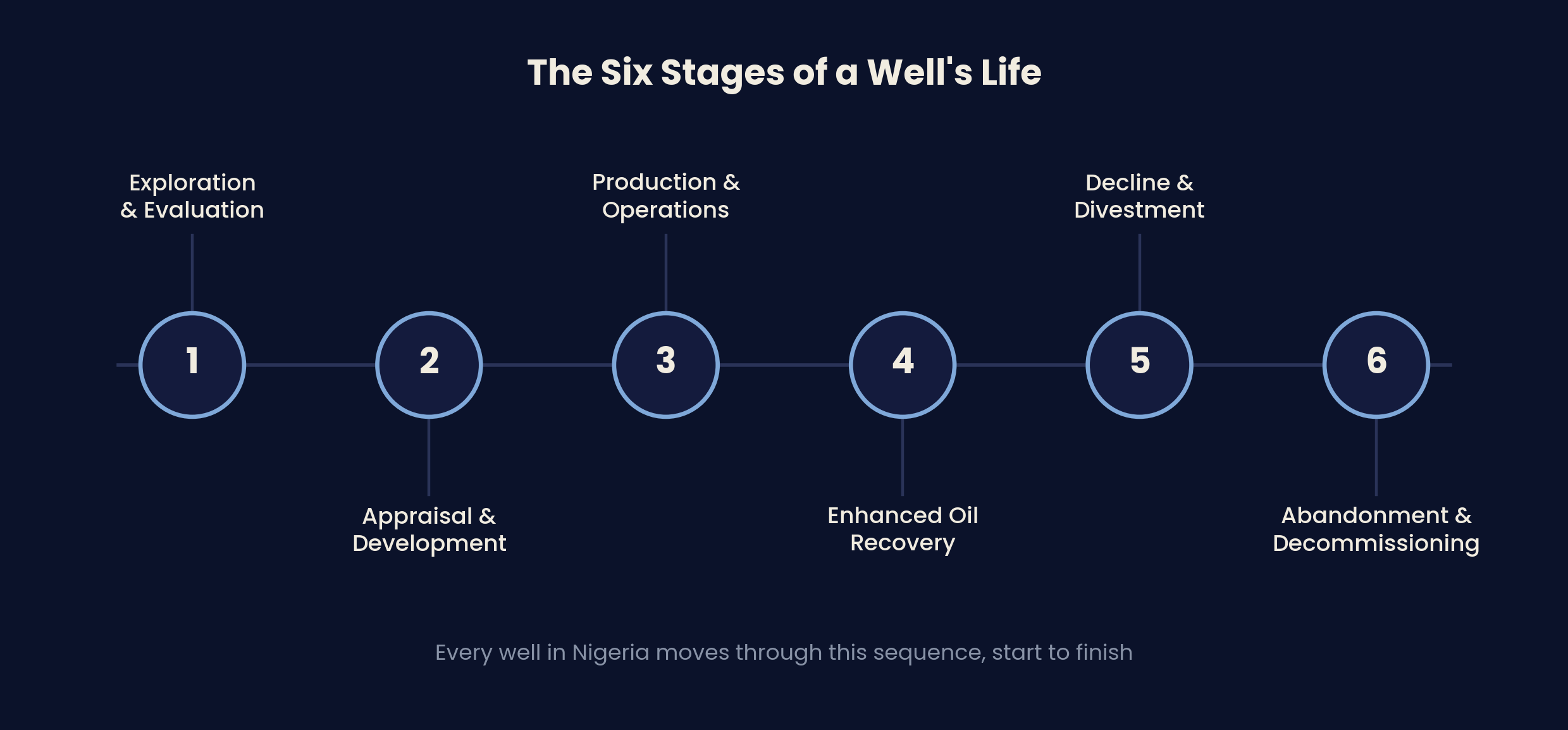
The Petroleum Industry Act 2021 and the Nigerian Upstream Petroleum Regulatory Commission recognize the well life cycle as comprising six distinct stages, each with its own regulatory requirements, capital profile, technical activities, and risk characteristics. These are: Exploration and Evaluation; Appraisal and Development; Production and Operations; Enhanced Recovery; Decline Management; and Decommissioning and Abandonment.
In practice, these stages blur into each other. A field may be simultaneously exploring new acreage in one area while managing production decline in another. Enhanced recovery work may begin before a field reaches true decline. Decommissioning planning, under good practice, starts at the same time as field development. But understanding each stage in isolation first allows us to understand how they connect, and why each one matters.
The Search Begins: Exploration and Evaluation
Before a single metre of well is drilled, before any rig is mobilized, before any capital commitment is made, the search begins. It begins with questions. What does the rock beneath this ground look like? Could it hold hydrocarbons? If it does, could they be economically produced? These questions are answered not by drilling, but by geophysics; the science of reading the earth through sound.
Reading the Earth: Geological and Geophysical Surveys
Petroleum geologists and geophysicists spend months or years analysing the subsurface before recommending a well location. In Nigeria, this begins with a review of existing geological data; outcrops, well logs from nearby wells, basin studies accumulated over decades; and then progresses to seismic surveys.
A seismic survey works like an ultrasound for the earth. Acoustic waves are generated at the surface; by vibrating trucks on land, by air guns towed by vessels offshore. These waves travel downward into the rock, bounce off geological layers at different depths, and return to surface receivers. The travel time and character of those returning signals are processed computationally to generate detailed images of the subsurface; two-dimensional cross-sections or three-dimensional volumetric models that show geologists where the sedimentary layers are, how they are arranged, and where structures that might trap hydrocarbons could exist.
In Nigeria’s Niger Delta, one of the world’s most thoroughly studied hydrocarbon basins, extensive 3D seismic coverage already exists across the onshore and shallow-water areas, accumulated over decades by Shell, ExxonMobil, Chevron, TotalEnergies, and numerous indigenous operators. However, the deepwater pre-salt plays being evaluated in upcoming licensing rounds require entirely new seismic acquisition programmes; the existing data was designed to image shallower targets and cannot resolve the structures being sought at greater depths.
Getting Permission: Exploration Licensing Under the PIA 2021
No company can conduct seismic surveys or drill a well in Nigeria without first securing the appropriate licence from NUPRC. The licensing framework established under the Petroleum Industry Act 2021 is built around two primary instruments.
The Two Key Exploration Licences in Nigeria
- Petroleum Prospecting Licence (PPL): Authorizes the holder to conduct geophysical surveys and drill exploration wells within a defined acreage block. A PPL is valid for three years, renewable once for a further two years on payment of the prescribed renewal fee and demonstration of work programme compliance. It is the entry point to Nigerian upstream acreage.
- Petroleum Mining Lease (PML): Awarded after a discovery has been appraised and a Field Development Plan approved by NUPRC. A PML authorizes production and is valid for up to 20 years for onshore leases and 30 years for offshore. Renewable on application to NUPRC.
- Environmental Impact Assessment (EIA): Required before any seismic or drilling activity under the Environmental Impact Assessment Act 1992. The EIA must assess the potential environmental and social impacts of the proposed operations and propose mitigation measures. No PPL activity can commence without a valid EIA approval from the Federal Ministry of Environment.
The Wildcat Well: Going In Blind
The first well drilled to test a geological prospect is called a wildcat well, or exploration well. The name carries an appropriate sense of risk. Globally, only 25 to 45 percent of exploration wells encounter commercially viable hydrocarbons (PNG 301: Introduction to Petroleum and Natural Gas Engineering, Penn State University, n.d.). Every exploration well is, in the deepest sense, an act of informed speculation: the best available science applied to a question that can only be answered by putting steel in the ground.
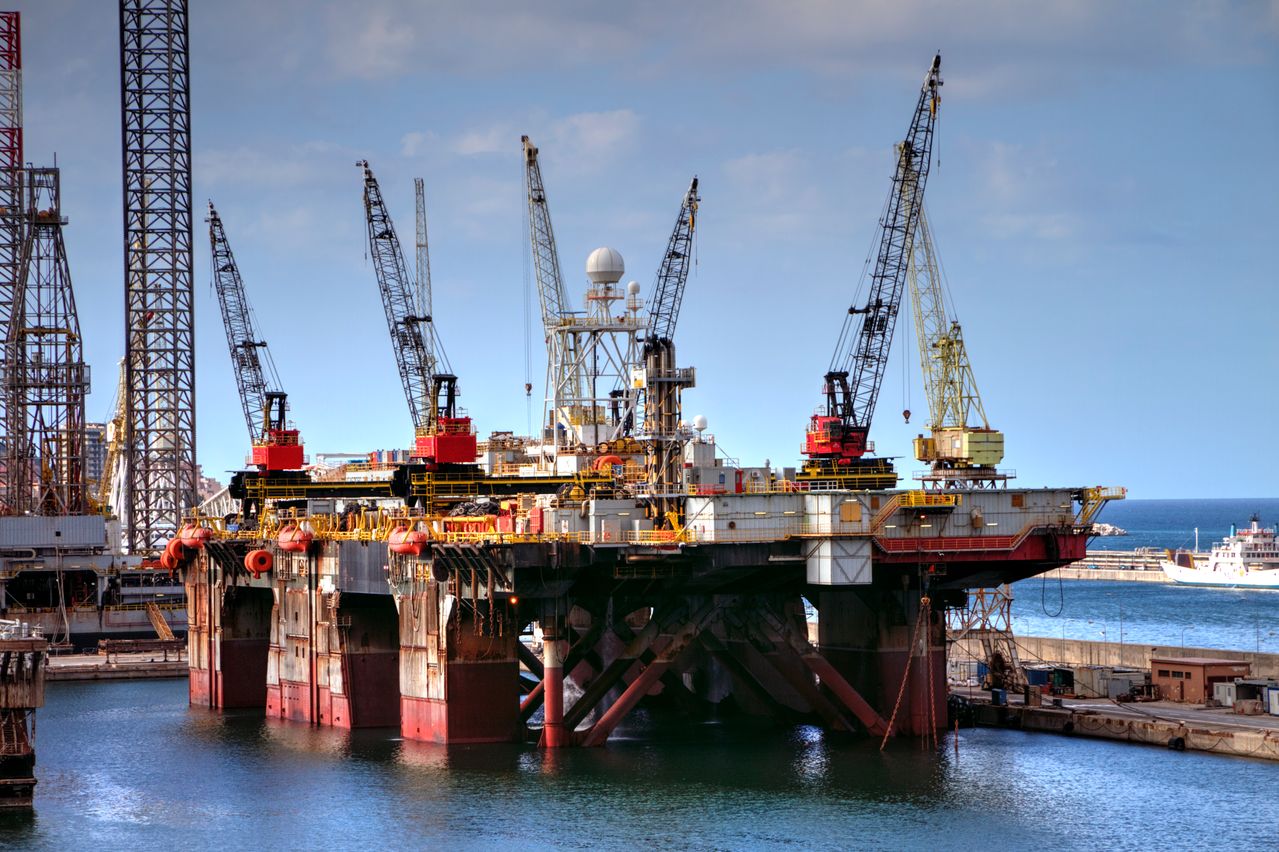
In Nigeria’s mature onshore Niger Delta, where decades of wells have built an extensive subsurface knowledge base, exploration success rates are somewhat higher than the global average. In deep pre-salt and frontier offshore plays, they are considerably lower. The economics of a company’s portfolio management depend heavily on managing this exploration risk: balancing high-risk, high-reward wildcats against lower-risk, lower-reward near-field exploration and infill drilling.
When an exploration well is drilled, the data gathered is exhaustive. Logging while drilling (LWD) tools provide continuous real-time measurements of the rock properties as the bit advances. Core samples are cut from potentially productive intervals and brought to surface for laboratory analysis. Wireline logging tools are lowered into the open wellbore to measure electrical resistivity, porosity, density, and sonic velocity. If the well shows hydrocarbons, a formation test is conducted to measure fluid properties and reservoir productivity. Every measurement feeds a model. Every model informs a decision.
An exploration well drilled in the right place at the right time launched Nigeria’s petroleum industry and changed the country’s economic trajectory forever. One drilled in the wrong place is simply a very expensive lesson in geology.
Proving the Prize: Appraisal and Development
When an exploration well encounters hydrocarbons, the celebrations are brief. The harder work is just beginning. A single well tells a geologist that oil or gas exists at this location. It says almost nothing about how much exists, over what area, at what quality, or whether it can be produced economically. The appraisal stage is about answering all of those questions with enough confidence to commit hundreds of millions of dollars to development.
Appraisal Wells: Mapping the Edges
Appraisal wells (also called delineation wells) are drilled at locations away from the discovery well to define the lateral extent of the reservoir and to characterise how reservoir quality varies across the field. Each one adds data points to the subsurface model, gradually replacing geological uncertainty with geological knowledge.
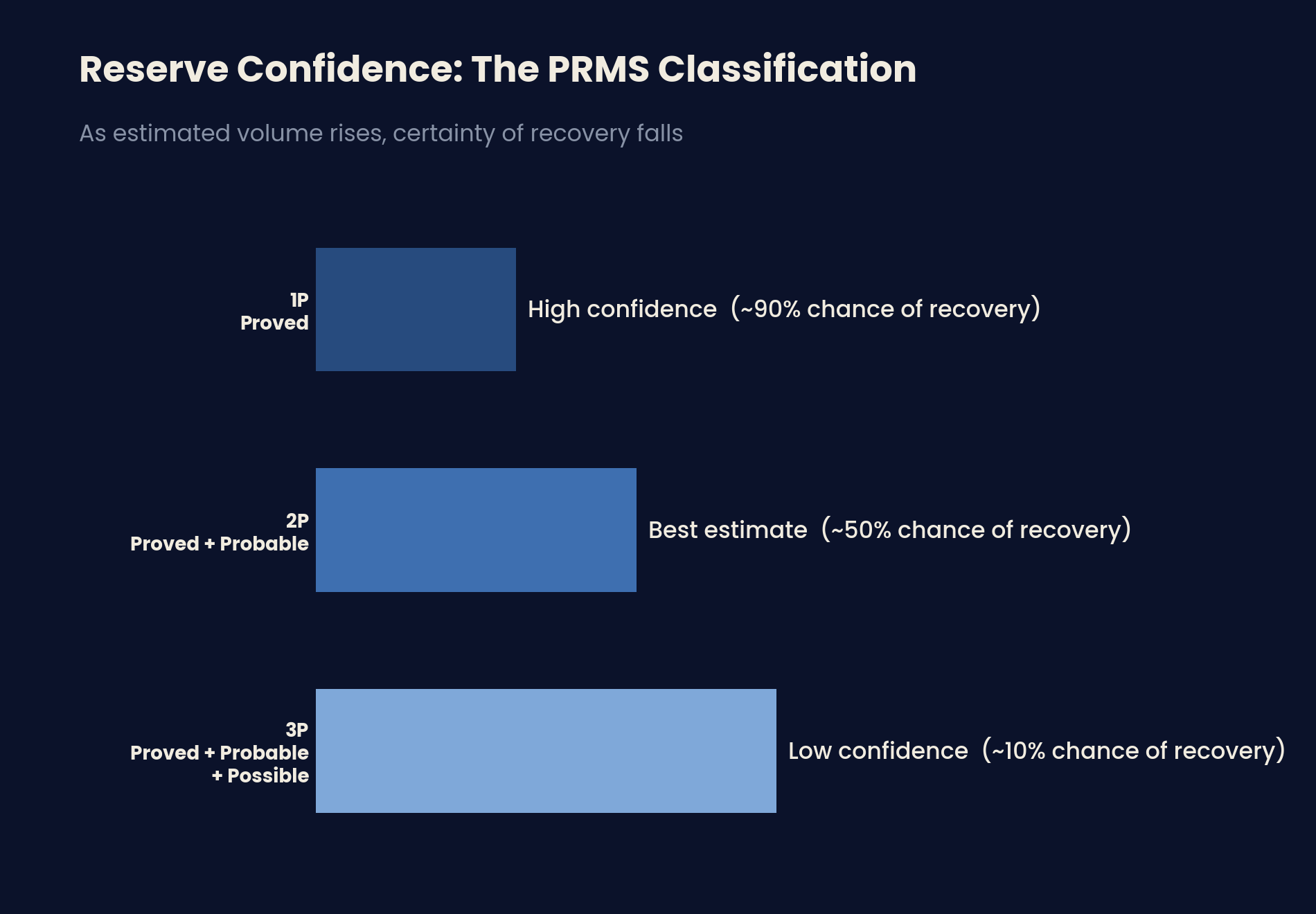
The data from appraisal wells is used to estimate the volume of recoverable hydrocarbons using the classification system of the Society of Petroleum Engineers Petroleum Resources Management System. This system creates three categories of increasing uncertainty.
The PRMS Reserve Classification System
- 1P (Proved Reserves): High-confidence estimate. At least 90 percent probability that the actual recoverable volume will equal or exceed this estimate. The most conservative number; used for financial reporting and as the basis for secured lending.
- 2P (Proved Plus Probable Reserves): Best estimate. At least 50 percent probability of recovery. The number most commonly used for investment decision-making and field development planning.
- 3P (Proved Plus Probable Plus Possible Reserves): Low-confidence estimate. At least 10 percent probability. Represents the optimistic upside scenario; useful for scenario planning but not for financial commitments.
In Nigeria, reserve classifications have direct commercial consequences: they underpin company asset valuations, determine the terms of joint venture agreements, size financing facilities, and feed into the government’s production-sharing calculations under the PIA 2021. Getting them right is not just a technical exercise. It is a legal and financial obligation.
The Field Development Plan: Blueprinting the Future
If appraisal confirms a commercially viable discovery, the operator must prepare a Field Development Plan and submit it to NUPRC for approval before any production drilling can begin. The FDP is the blueprint for everything that follows. It describes the number and locations of development wells; the surface facilities required (flow stations, pipelines, export terminals); the production profile over time and the expected plateau rate; the capital expenditure and operating expenditure estimates across the field life; the environmental management plan; and the decommissioning security arrangements.
Field development in Nigeria typically takes three to seven years from discovery to first oil, depending on the complexity of the project, regulatory approval timelines, the requirements of community engagement and host community trust fund establishment under the PIA 2021, and the availability of financing. That timeline is not short. Every month it extends is a month of capital deployed without return.
Well Construction: Building from Scratch
Development wells are drilled according to a well programme approved by NUPRC. The construction of a single well is itself a multi-stage operation that may take several weeks to several months, depending on depth and complexity.
Spud: The formal commencement of drilling. When the drill bit first penetrates the ground surface and the well officially begins to exist.
Surface Hole and Casing: Drilling the large-diameter top section (typically 26-inch or 17.5-inch hole) and cementing conductor and surface casing to stabilize the shallow formation, protect freshwater aquifers, and support the wellhead structure above. This is the foundation on which everything else is built.
Intermediate Hole and Casing: Drilling through the intermediate formations and setting casing to seal off problematic intervals; overpressured zones, lost circulation intervals, H2S-bearing formations. This section of the well is where the Nigerian subsurface throws its most unpredictable challenges at the drilling engineer.
Production Hole: Drilling to the target reservoir depth and evaluating the productive interval through logging while drilling, wireline logging, and formation testing. The data gathered here determines how the well will be completed.
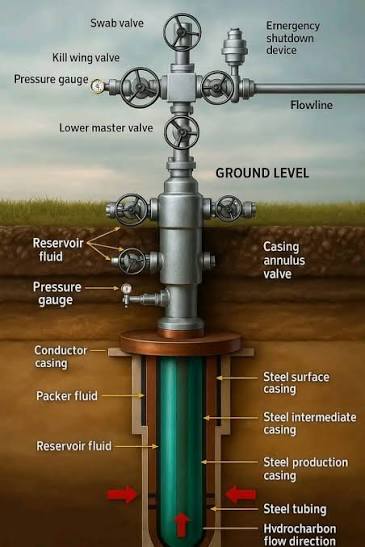
Completion: Installing production tubing, packers, and downhole safety valves; then perforating the reservoir interval to create channels through the casing and cement into the rock, allowing hydrocarbons to flow into the wellbore. A completion is a carefully engineered system designed to maximize production while maintaining well integrity for years or decades.
Wellhead Installation: Installing the Christmas tree: the stack of valves, fittings, and gauges at the surface that controls all flow from the well and provides the interface between the wellbore and the surface production facilities.
The Well Earns Its Keep: Production and Operations
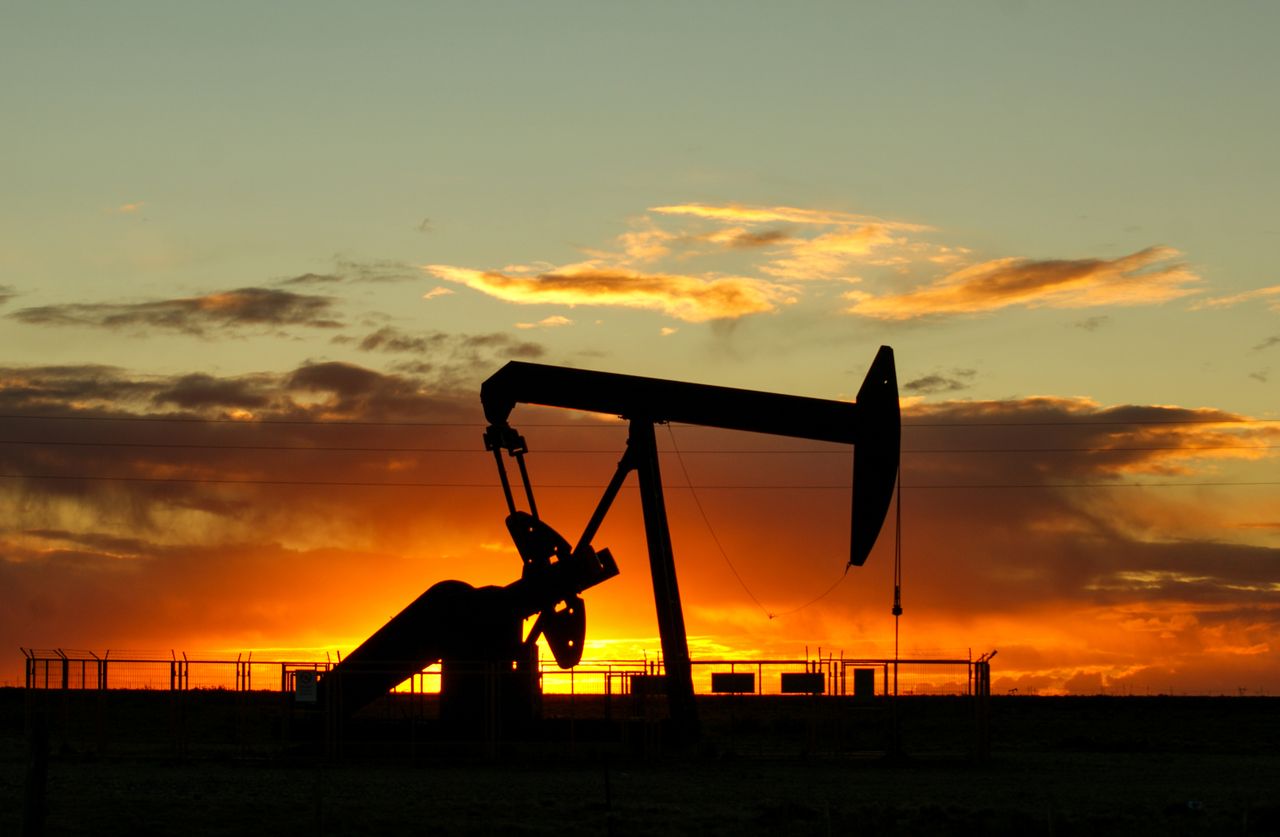
The production phase is the reason the well exists. Everything before it was preparation. Everything after it will be consequence. This is the stage during which the earth’s stored wealth becomes electricity, fuel, plastics, government revenue, and livelihoods.
And it does not simply happen. A producing well is a dynamic, living system that requires continuous monitoring, regular intervention, and relentless engineering attention to keep performing at its best.
The Production Profile: A Story in Three Acts
Every producing well follows a broadly similar production arc, though the details vary enormously depending on reservoir type, drive mechanism, and operational management.
Buildup Phase: Production rates increase as reservoir pressure depletes the near-wellbore zone and flow pathways stabilize. This phase may last months to a few years, and its character tells the reservoir engineer a great deal about the reservoir’s connectivity and drive mechanism.
Plateau Phase: Production stabilizes at the design rate. New wells are drilled to replace declining individual well contributions and maintain field aggregate output at the plateau level. This is the most commercially valuable phase; the period during which the capital invested in development is earning its highest returns.
Decline Phase: Natural reservoir energy diminishes as fluids are withdrawn. Production rates fall along a characteristic curve that may be exponential, hyperbolic, or harmonic depending on the reservoir’s drive mechanism. Decline curve analysis, one of the most important quantitative tools in production engineering, uses this curve to forecast future production and to estimate remaining reserves.
Nigeria’s crude production averaged approximately 1.54 million barrels per day in 2024, significantly below the 2 million barrels per day peak of the mid-2000s (Nigeria Oil Production, Reserves and Consumption Statistics, U.S. Energy Information Administration, 2025). This gap reflects a combination of natural decline in the mature fields that have been producing for 40 or more years, production disruptions from infrastructure damage and oil theft in earlier years, and the gradual recovery now underway as pipeline security improvements and new infill drilling programmes restore output.
Daily Life on a Producing Well: What Operations Actually Look Like
A producing well is never simply left to produce on its own. A production operations team manages a continuous programme of monitoring and intervention activities.
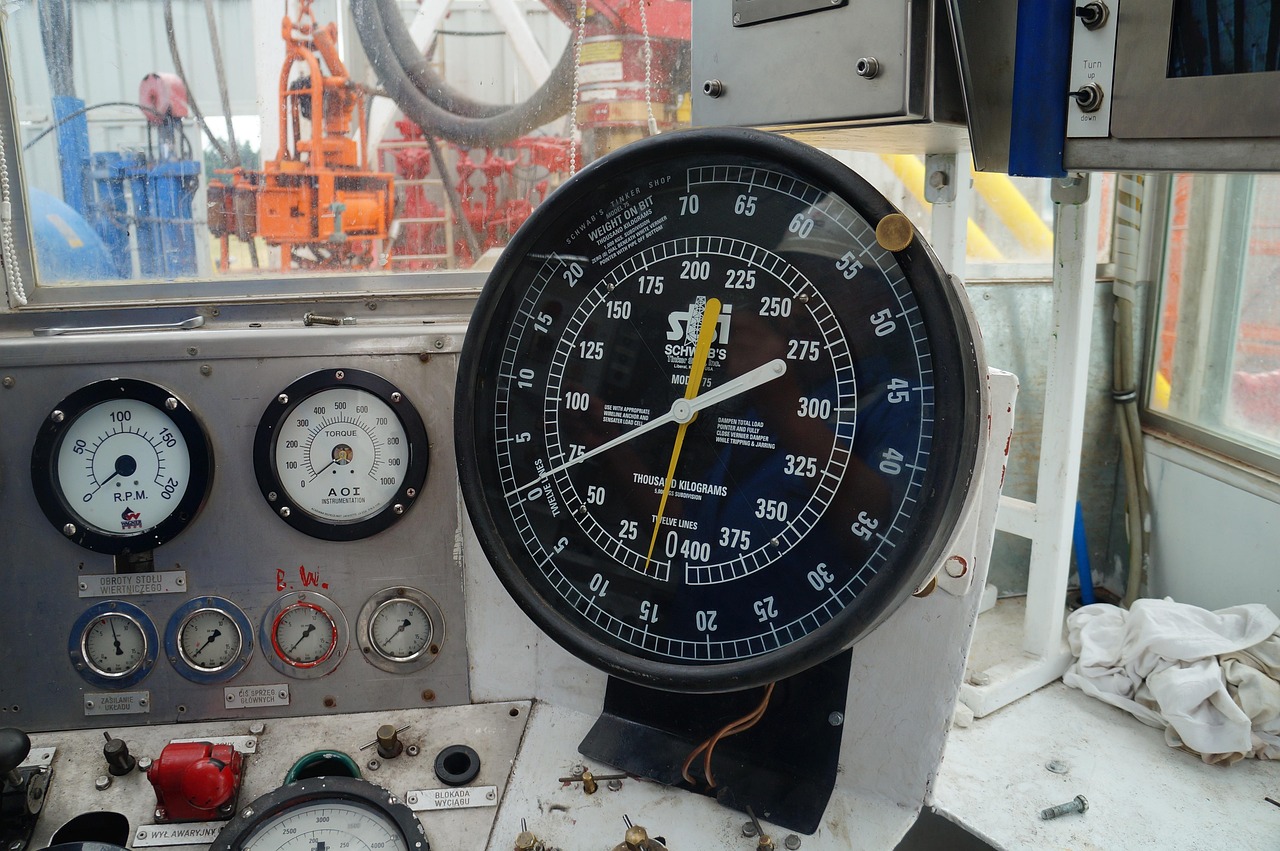
Well Surveillance: Daily or weekly measurement of oil, gas, and water production rates using test separators and multiphase flow meters. Well performance is tracked against decline curve models. Any deviation from the expected trend triggers investigation; it could indicate a blockage, a leak, a change in reservoir behavior, or the onset of unwanted water production.
Well Interventions: Regular operations to maintain or improve well productivity. These include stimulation treatments (acidizing to dissolve near-wellbore damage; hydraulic fracturing to create flow pathways in tight reservoirs); coiled tubing cleanouts to remove sand or scale deposits from the wellbore; wireline logging to update the subsurface model; and artificial lift installation when reservoir pressure is no longer sufficient to lift fluids to surface naturally.
Produced Water Management: As reservoirs mature, water production increases. In Nigeria’s mature Niger Delta fields, produced water volumes can exceed oil volumes by 10 to 1 (Physicochemical Assessment and Treatment of Produced Water: A Case Study in Niger Delta Nigeria, Amakiri et al., 2023). Managing this produced water; separating it from the oil, treating it to meet disposal specifications, and reinjecting it or disposing of it without environmental harm; is one of the most significant operational challenges in the industry. Produced water handling failures have caused some of the Niger Delta’s most damaging spills.
Flow Assurance: Managing the formation of wax deposits, asphaltene precipitates, hydrate plugs, and mineral scale within the wellbore and flowlines. In the Niger Delta’s waxy crude production streams and the Deepwater’s cold-temperature flow paths, flow assurance is not a secondary concern. It is a primary operational discipline. A wax plug in a deepwater flowline can take days to remediate and cost millions of dollars in lost production.
Fighting Decline: Enhanced Oil Recovery
Natural reservoir energy is finite. Every barrel of oil produced removes a small amount of the pressure that drives production. Every molecule of gas that escapes take energy with it. Eventually, the reservoir is no longer strong enough to push its remaining fluids to the surface without help.
Enhanced Oil Recovery is the collective name for the techniques that provide that help; methods that supplement or replace natural reservoir energy to extend the productive life of a field and recover hydrocarbons that primary production would leave behind.
Water Flooding: Nigeria’s Most Widespread EOR Method
Water injection is already widely practiced in Nigeria as a secondary recovery method. Water is pumped into the reservoir through dedicated injector wells at the periphery of the field, sweeping residual oil from the pore spaces of the rock toward producer wells at the Centre. Properly designed and managed, waterflooding can significantly improve recovery factors compared to primary depletion alone.
The design of a waterflood requires detailed reservoir modelling; understanding the geometry of the reservoir, its permeability distribution, and the likely water movement paths. A poorly designed waterflood sweeps water past recoverable oil rather than through it, achieving high water production at low oil recovery. A well-designed one can recover a significant additional fraction of the oil in place.
Gas Injection: Turning a Problem into a Solution
Associated gas; the gas that comes out of solution with crude oil as it is produced; has historically been one of Nigeria’s most visible and most embarrassing problems. For decades, the gas that could not be economically processed or transported was simply burned at the wellhead, creating the flare stacks that have lit the Niger Delta sky and poisoned its air for generations.
Gas reinjection offers a different answer. By compressing produced gas and injecting it back into the reservoir, operators can simultaneously reduce flaring (addressing an environmental imperative) and maintain or restore reservoir pressure (addressing a production imperative). It is one of the few interventions in the oil industry where environmental responsibility and economic rationality align perfectly.
Chemical EOR: The Frontier Being Tested in Nigeria
Chemical Enhanced Oil Recovery involves injecting polymer solutions, surfactants, alkaline chemicals, or combinations of these into the reservoir to improve sweep efficiency and reduce the interfacial tension between oil and water that traps oil in rock pores.
Polymer flooding increases the viscosity of the injected water, making it a more effective displacing fluid. Surfactants reduce the surface tension that causes oil to cling to rock surfaces. Alkaline-surfactant-polymer (ASP) combinations address multiple recovery mechanisms simultaneously.
In Nigeria, chemical EOR pilot projects have been undertaken in the Warri and Forcados fields. The results of these pilots, and the lessons from field experience in other mature basins globally, are informing the design of larger-scale programmes. As Nigeria’s major onshore fields age and decline accelerates, chemical EOR represents one of the most significant remaining opportunities to extend their productive lives.
Managing the Autumn: Decline and the Great Divestment
Every field has an autumn. The plateau gives way to decline. The water cut climbs. The production rate falls. The question shifts from how to maximize output to how to optimize remaining production at minimum cost, and when to transfer or walk away from assets that no longer justify their overheads.
In Nigeria, this stage of the well life cycle has recently taken on an extraordinary additional dimension: a historic transfer of asset ownership that is reshaping the structure of the entire upstream industry.
The Great Divestment: IOCs Exit, Indigenous Operators Arrive
The Petroleum Industry Act 2021 introduced specific provisions encouraging the divestiture of aging onshore and shallow-water assets from International Oil Companies to indigenous Nigerian operators. The logic was sound: indigenous operators often have lower cost structures, stronger community relationships, and greater motivation to invest in maximizing recovery from assets that an IOC with global portfolio choices might regard as sub-scale.
The result has been one of the most significant restructurings in Nigerian petroleum history. Shell sold its entire onshore subsidiary to Renaissance Energy. ExxonMobil divested its Nigerian onshore assets to Seplat. Chevron’s transactions with indigenous partners advanced. TotalEnergies restructured its onshore portfolio. Eni completed a major transaction with Oando (Nigeria Approves Exxon-Seplat Deal, Blocks Shell Sale, Reuters, 2024; Shell Completes Sale of Nigerian Onshore Assets, Rigzone, 2025).
This wave of divestments has not been without controversy. UN human rights experts raised concerns in 2025 that some transactions were completed without adequate environmental remediation of legacy spill sites, and that the acquiring companies may not have the financial resources to address liabilities accumulated over decades by the sellers (UN Experts Accuse Top Oil Firms of Rights Violations Over Nigerian Asset Sales, Climate Home News, 2025). These concerns are real and deserve serious regulatory attention from NUPRC. The PIA 2021’s financial assurance requirements for decommissioning are part of the response, but the gap between what those requirements demand and the actual environmental liability that some divested assets carry is, in some cases, substantial.
The Decommissioning Liability Hidden in Every Divestment
When an IOC sells an aging Nigerian oil field to an indigenous operator, the purchase price reflects current production value. The decommissioning liability (the cost of properly plugging every well, dismantling every facility, and restoring every site to its pre-drilling condition) is a future obligation that may not be fully captured in the transaction.
The Commonwealth Secretariat’s Oil and Gas Decommissioning Toolkit estimates that decommissioning costs for major fields can easily reach hundreds of millions to billions of dollars.
Nigeria’s NUPRC Decommissioning and Abandonment Regulations 2023 require operators to establish financial security mechanisms (bonds, escrow accounts, or parent company guarantees) to ensure decommissioning funds are available. The adequacy of these provisions for the scale of Nigeria’s legacy decommissioning challenge is a question that regulators, investors, and communities must all ask.
The Final Act: Abandonment and Decommissioning
A well dies when the economics no longer support its life. When the revenue from the oil it produces can no longer cover the cost of producing it: the lifting costs, the water treatment, the maintenance, the regulatory compliance overhead. The well reaches what engineers call its economic limit. At that point, continuing to produce is not just uneconomical. It is a distraction from assets that deserve the attention.
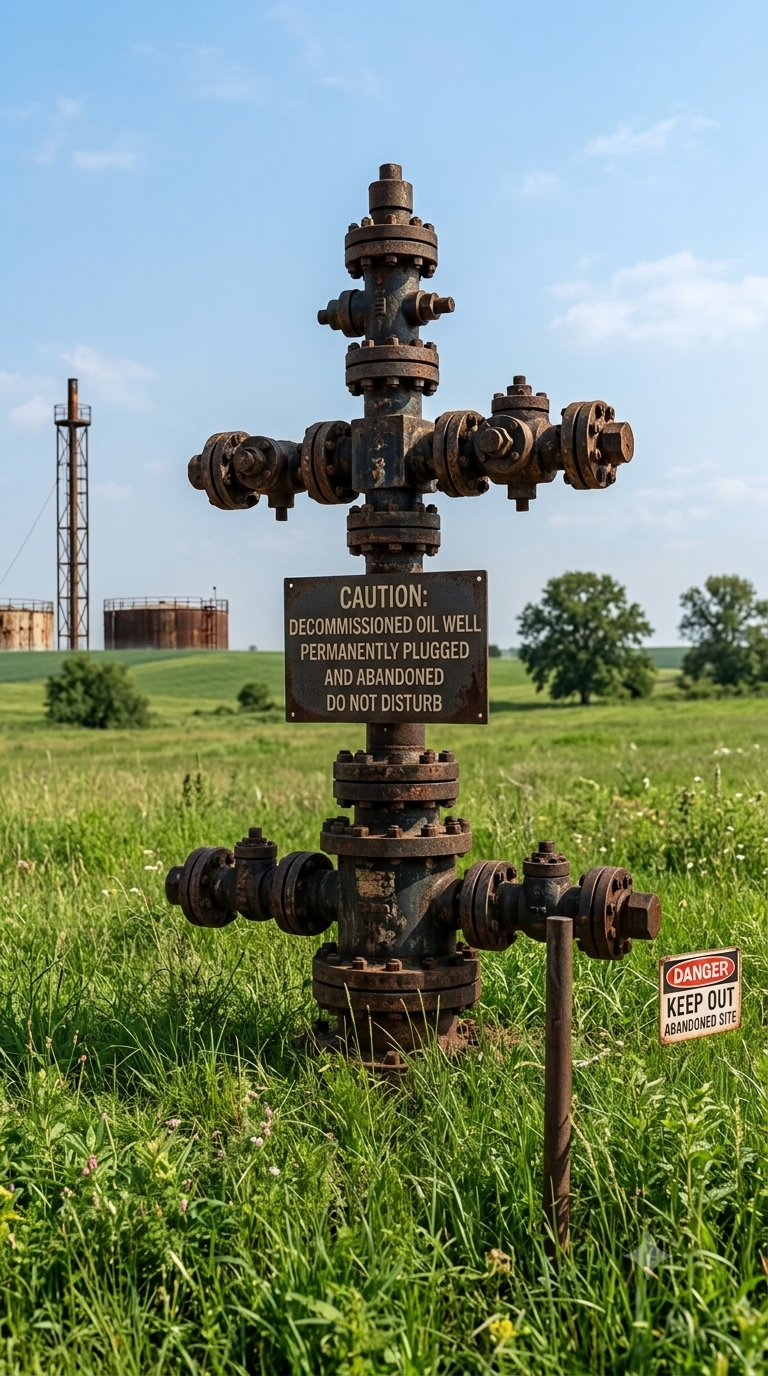
But a dead well is not an abandoned responsibility. It is a sealed reservoir, a removed wellhead, a restored surface, and a long monitoring commitment. Done properly, well abandonment returns the site to something close to its pre-drilling condition. Done improperly, it leaves a legacy of environmental liability that outlasts every company involved in the original development.
The Abandonment Procedure: Every Step Matters
Well abandonment in Nigeria must follow procedures approved by NUPRC under the Nigerian Upstream Petroleum Decommissioning and Abandonment Regulations 2023. The procedure is not a single action. It is a structured sequence, each step of which has a specific engineering purpose.
The Well Abandonment Sequence
- Shut-In and Isolation: Production is ceased and the reservoir intervals are isolated using bridge plugs or cement retainers. No hydrocarbon flow path from the reservoir to the wellbore can remain open.
- Perforation Squeeze Cementing: Cement is injected through the perforations back into the reservoir rock, permanently sealing the channels that allowed production to flow. This step eliminates the most direct pathway for any future formation fluid migration.
- Mechanical Plug Placement: Qualified wellbore barriers (cement plugs and mechanical bridge plugs) are set at multiple points within the casing string. Nigerian regulations require a minimum of two independent barriers at each critical zone. Each plug is pressure tested to verify its integrity before the operation continues.
- Wellhead Removal: After confirming wellbore integrity by pressure testing the plug system, the Christmas tree and above-ground wellhead structure are removed. Any wellhead valves or fittings that remain in the wellbore are confirmed to be in a position that ensures long-term containment.
- Site Restoration: The wellsite is cleared of all above-ground infrastructure: concrete pads, access roads, security fencing, storage facilities. The surface is graded, topsoil is replaced, and vegetation is re-established. In the Niger Delta, this also means addressing any soil or water contamination from the drilling and production operations.
- Long-Term Monitoring: Some Nigerian wellbores require post-abandonment monitoring for groundwater contamination, surface gas seeps, or subsidence. This obligation does not end with abandonment. It continues for as long as there is a credible risk of environmental impact.
Beyond Abandonment: The Wells That Could Live Again
Not all decommissioning is purely an ending. Across the world, the industry is waking up to the possibility that some abandoned wells have a second life, not as oil producers, but as infrastructure for different purposes.
Abandoned Wells and Their Second Lives
- Geothermal Energy: Deep wells in areas with sufficient geothermal gradient can be repurposed to extract heat from the earth for power generation or direct heating applications. Nigeria’s deep wells in the Niger Delta, where formation temperatures at depth can exceed 150 degrees Celsius, are candidates for evaluation.
- CO2 Sequestration: Wells in suitable geological formations can be used to inject and permanently store carbon dioxide captured from industrial processes. Nigeria’s National Carbon Market commitments under the PIA 2021 create a regulatory framework within which this application could be developed.
- Produced Water Disposal: A decommissioned well that penetrates a suitable formation can be permitted as a saltwater disposal well, providing a regulated pathway for the enormous volumes of produced water generated by nearby active fields.
- Groundwater Monitoring: Former wellbores provide ready-made access to subsurface formations, making them valuable as observation wells for groundwater monitoring programmes.
These alternative uses are not theoretical. They are being actively pursued in North America, the North Sea, and parts of Southeast Asia. In Nigeria, where the decommissioning bill for thousands of aging wells will be enormous, any opportunity to offset those costs deserves serious evaluation.
The Well Life at a Glance
The table below brings the six stages together, showing the typical timeline, the key activities at each stage, the regulatory authority responsible, and what makes each stage distinctive in the Nigerian context.
| Phase | Typical Duration | Key Activities | Nigerian Regulator | What Makes This Phase Distinctive |
|---|---|---|---|---|
| Exploration | 2 to 10 years | Seismic surveys, wildcat well drilling, data gathering | NUPRC (PPL) | Highest geological risk, typically 25 to 45% success rate |
| Appraisal | 1 to 3 years | Appraisal wells, resource classification, FDP preparation | NUPRC | Confirms commercial viability, defines reserve size |
| Development | 3 to 7 years | Well construction, facilities build, first oil | NUPRC, FMEnv | Highest capital expenditure phase |
| Production | 10 to 40+ years | Operations, workovers, EOR, produced water management | NUPRC, NMDPRA | Most commercially valuable phase of well life |
| Decline Mgmt. | 5 to 20 years | Cost optimization, infill drilling, workover programme | NUPRC | IOC divestments to indigenous operators increasingly common |
| Abandonment | 1 to 3 years | Plug and abandon, wellhead removal, site restoration | NUPRC (DAR 2023) | Requires financial security provisions under PIA 2021 |
From First Light to Final Silence
Stand at Oloibiri today and you are standing at both the beginning and an illustration of the end. The first commercial well in Nigerian history has completed its journey. The hydrocarbons it once carried to the surface are long since refined, burned, and dispersed into the global atmosphere. The infrastructure is largely gone. The community remains, navigating a post-oil future that the industry had decades to help prepare them for, and did not always do so.
Thousands of wells across the Niger Delta are following in Oloibiri’s footsteps, at various stages of that same journey. Some are still in their productive prime. Some are declining. Some are already abandoned, plugged by cement and sealed by regulations that did not exist when they were drilled. And some were abandoned decades ago under standards that would not be acceptable today, their legacies still seeping into the groundwater and the soil of the communities around them.
Understanding the full life cycle of a well, not just the exciting discovery and the profitable plateau, but the decline, the decommissioning, and the long-term monitoring obligation; is what separates petroleum development that creates lasting value from petroleum development that creates lasting damage.
Nigeria holds 37 billion barrels of proven oil reserves (National Petroleum Reserves Declaration, NUPRC, 2025). Each one of those barrels will be produced from a well that has a beginning, a middle, and an end. The quality of the industry, the integrity of the nation’s stewardship of its resources, and ultimately the legacy left to the communities that have hosted this industry for 70 years: all of these things are decided not just by how well the oil is found and produced, but by how responsibly the full life cycle is managed.
The well at Oloibiri is silent now. What it leaves behind, and what every well drilled in Nigeria leaves behind, is a question about the kind of petroleum industry this country chooses to have.
Glossary: Plain-Language Guide to Key Terms
A reference guide to the technical vocabulary used in this article, for readers who are new to petroleum engineering and well operations.
- Well Life Cycle: The complete sequence of stages through which an oil or gas well passes from initial exploration through to final abandonment and site restoration. In Nigeria, the PIA 2021 and NUPRC recognize six stages: Exploration; Appraisal and Development; Production and Operations; Enhanced Recovery; Decline Management; and Decommissioning and Abandonment.
- Seismic Survey: A geophysical technique for imaging the subsurface by generating acoustic waves at the surface and measuring the travel time and character of their reflections from underground rock layers. The primary exploration tool used in Nigeria and worldwide to identify geological structures that may trap hydrocarbons. Produces 2D cross-sections or 3D volumetric images of the subsurface.
- Wildcat Well (Exploration Well): The first well drilled to test a geological prospect. So called because it ventures into unproven territory. Globally, only 25 to 45 percent of wildcat wells encounter commercially viable hydrocarbons (PNG 301: Introduction to Petroleum and Natural Gas Engineering, Penn State University, n.d.). In Nigeria’s mature Niger Delta, success rates are somewhat higher due to extensive subsurface knowledge.
- Petroleum Prospecting Licence (PPL): A licence issued by NUPRC under the PIA 2021 authorizing the holder to conduct geophysical surveys and drill exploration wells within a defined acreage block in Nigeria. Valid for three years, renewable once. The entry point to Nigerian upstream acreage.
- Petroleum Mining Lease (PML): A lease issued by NUPRC authorizing production from a discovered and appraised field in Nigeria. Awarded after approval of a Field Development Plan. Valid for up to 20 years (onshore) or 30 years (offshore), renewable on application.
- PRMS (Petroleum Resources Management System): The international standard for classifying and estimating petroleum reserves and resources, published by the Society of Petroleum Engineers. Defines 1P (Proved), 2P (Proved plus Probable), and 3P (Proved plus Probable plus Possible) reserve categories with specific probability thresholds.
- Field Development Plan (FDP): A comprehensive document submitted by an operator to NUPRC describing how a discovered hydrocarbon field will be developed and produced. Covers well numbers and locations, production profile, facilities design, capital and operating cost estimates, environmental management, and decommissioning provisions. NUPRC approval of the FDP is required before production drilling begins.
- Spud: The formal start of drilling a well, when the drill bit first penetrates the ground. The spud date is the official commencement date recorded in NUPRC well records.
- Completion: The operations performed after drilling reaches the target reservoir depth to prepare the well for production. Includes installing production tubing, packers, and safety valves in the wellbore; perforating the reservoir interval; and testing the well to confirm flow capability. The completion design determines how the well will produce throughout its life.
- Christmas Tree: The assembly of valves, fittings, and gauges installed on top of a producing well at the surface. Controls all flow from the well and provides the interface between the wellbore and the surface production facilities. The visual signature of a producing oil or gas well.
- Decline Curve Analysis: A quantitative reservoir engineering method that uses the historical production rate decline of a well or field to forecast future production and estimate remaining recoverable reserves. One of the most widely used tools in production management and reserve estimation.
- Water Cut: The proportion of produced fluid that is water rather than oil, expressed as a percentage. In Nigeria’s mature fields, water cuts of 80 percent or more are common; some wells produce 10 or more barrels of water for every barrel of oil (Niger Delta Oilfields Produced Water Characteristics and Treatment Technologies, Nwokoma and Dagde, 2024). Managing produced water is a major operational and environmental challenge.
- Enhanced Oil Recovery (EOR): A collective term for techniques that supplement natural reservoir energy to improve oil recovery beyond what primary and secondary (waterflood or gas injection) methods achieve. Includes chemical EOR (polymer flooding, surfactants), thermal EOR (steam injection), and miscible gas injection. Nigeria has active pilot programmes and early commercial EOR projects.
- Artificial Lift: Any technique used to bring reservoir fluids to the surface when natural reservoir pressure is insufficient to do so on its own. Common methods in Nigeria include Electric Submersible Pumps (ESPs) installed inside the wellbore, gas lift (injecting gas down the tubing annulus to lighten the fluid column), and rod pumps for shallow wells.
- Flow Assurance: The discipline of ensuring that hydrocarbons flow continuously and without obstruction from the reservoir to the processing facility. Addresses the formation of wax, asphaltene, hydrates, and scale deposits that can plug wellbores and flowlines. Particularly critical in deepwater Nigeria where low seabed temperatures favor hydrate formation.
- Economic Limit: The production rate at which a well’s or field’s revenue no longer covers its operating costs, and continued production generates negative cash flow. Reaching the economic limit triggers the abandonment decision. Varies significantly depending on oil price: a well that is sub-economic at USD 40 per barrel may be profitable at USD 80 per barrel.
- Plug and Abandon (P&A): The formal engineering and regulatory process of permanently sealing a well at the end of its producing life. Involves setting cement and mechanical plugs at multiple points in the wellbore to permanently isolate the reservoir and prevent any future migration of hydrocarbons or formation fluids. Conducted under NUPRC oversight in Nigeria.
- Decommissioning and Abandonment Regulations 2023: Regulations issued by NUPRC under the PIA 2021 governing the process and requirements for decommissioning upstream oil and gas wells and facilities in Nigeria. Require operators to submit abandonment programmes to NUPRC for approval and to establish financial security mechanisms (bonds, escrow accounts) to guarantee that decommissioning funds are available.
- NUPRC: Nigerian Upstream Petroleum Regulatory Commission. Established under the Petroleum Industry Act 2021 to regulate Nigeria’s upstream petroleum sector, including exploration licensing, well programme approvals, production monitoring, and decommissioning oversight. Absorbed the functions of the former Department of Petroleum Resources (DPR).
- IOC (International Oil Company): A large, internationally operating petroleum company such as Shell, ExxonMobil, TotalEnergies, Chevron, or Eni. IOCs have historically dominated Nigeria’s upstream sector but have been divesting onshore and shallow-water assets to indigenous operators since 2021, retaining a focus on deepwater operations.
Sources and Further Reading
- Ajudua, Bobo F. From Exploration to Decommissioning: A Guide to Regulatory Compliance in Nigeria’s Oil and Gas Lifecycle. Global Law Experts / Law Firm B.F.A and Co. Legal, 2025.
- NUPRC. Nigerian Upstream Petroleum Decommissioning and Abandonment Regulations, 2023. Abuja: Nigerian Upstream Petroleum Regulatory Commission.
- Petroleum Industry Act (PIA), 2021. Federal Republic of Nigeria.
- Ogeer, Naadira. Oil and Gas Decommissioning Toolkit: Practical Guidance for Governments. London: Commonwealth Secretariat, 9 November 2022. ISBN: 9780850920031. DOI: 10.14217/comsec.1078.
- Penn State University. PNG 301: Introduction to Petroleum and Natural Gas Engineering, Lesson 8: Well Life Cycle. Available at: e-education.psu.edu/png301.
- Tullow Oil plc. The Oil Life Cycle. Available at: tullowoil.com/about-us/oil-life-cycle.
- SPE/WPC/AAPG/SPEE/SEG/SPWLA/EAGE. Petroleum Resources Management System (PRMS), Revised June 2018 (Version 1.03). Richardson TX: SPE, 2018.
- American Society of Mechanical Engineers (ASME). B31.4: Pipeline Transportation Systems for Liquids and Slurries. New York: ASME, 2019.
- American Society of Mechanical Engineers (ASME). B31.8S: Managing System Integrity of Gas Pipelines. New York: ASME, 2022.
- DNV. DNVGL-RP-F116: Integrity Management of Submarine Pipeline Systems. Hovik: DNV, 2017 (updated 2021).
- NUPRC. National Petroleum Reserves Declaration. Abuja: Nigerian Upstream Petroleum Regulatory Commission, 2025.
- U.S. Energy Information Administration. Nigeria Oil Production, Reserves and Consumption Statistics. Washington, DC: EIA, 2025.
- Amakiri, K.T., Ogolo, N.A., and Angelis-Dimakis, A. Physicochemical Assessment and Treatment of Produced Water: A Case Study in Niger Delta Nigeria. Petroleum Research, 2023.
- Nwokoma, D.B., and Dagde, K.K. Niger Delta Oilfields Produced Water Characteristics and Treatment Technologies: Challenges and Solutions. American Journal of Chemical Engineering, 2024.
- Climate Home News. UN Experts Accuse Top Oil Firms of Rights Violations Over Nigerian Asset Sales. 2025.
- Reuters. Nigeria Approves Exxon-Seplat Deal, Blocks Shell Sale. 2024.
- Rigzone. Shell Completes Sale of Nigerian Onshore Assets. 2025.
Image credits: refinery sunset and rig-gauge photographs via Pixabay (contributors gaburibe76 and Anita Starzycka); storage terminal, semi-submersible rig, drilling rig, and pump jack photographs via Pexels (contributors Tom Fisk, mmg cancelli, Joseph Martin, and Jan Zakelj). Diagrams and cover image produced for BRADE Group.